










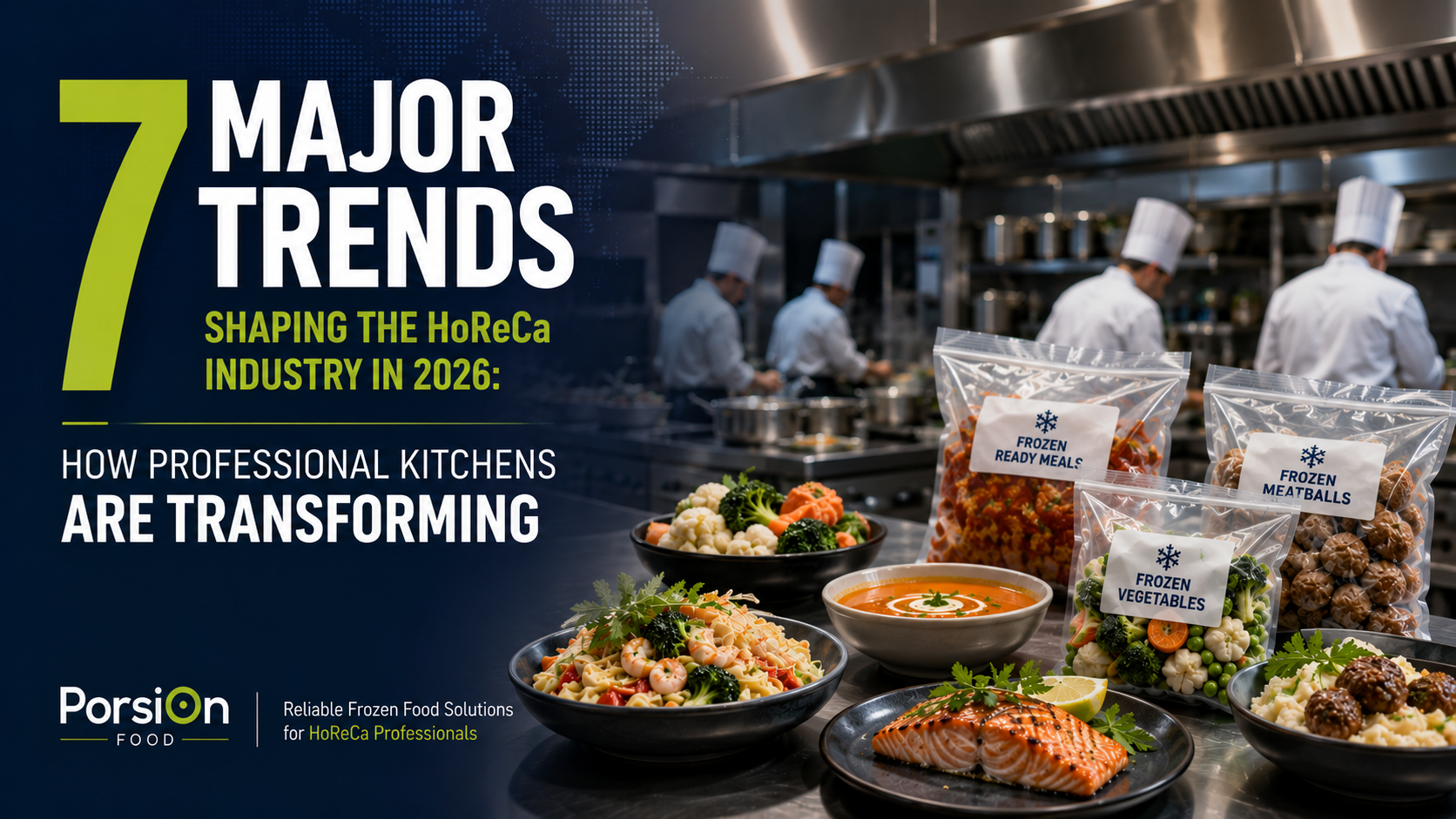
7 Major Trends Shaping the HoReCa Industry in 2026: How Professional Kitchens Are Transforming



A New Era for the HoReCa Industry
The HoReCa industry is undergoing a significant transformation driven by evolving customer expectations, technological advancements, sustainability initiatives, cost management, and the need for greater operational efficiency. Hotels, restaurants, cafés, catering companies, and institutional food service providers are no longer competing solely on taste. Today, success also depends on speed, consistency, hygiene, cost control, and sustainable operations.
As we enter 2026, professional kitchens are facing new realities, including rising energy costs, changing consumer preferences, and ongoing labor shortages. In this environment, partnering with the right food supplier, implementing effective kitchen management practices, and optimizing daily operations have become more important than ever.
Frozen food solutions are no longer viewed simply as time-saving products. Instead, they have become a strategic investment that improves operational efficiency. Their advantages including consistent product quality, extended shelf life, portion control, and reduced food waste make frozen foods an increasingly valuable solution for the growing demands of the HoReCa sector.
So, what trends will shape professional kitchens in 2026? Here are the seven key developments transforming the future of the industry.
1. Efficiency and Speed Are Becoming Top Priorities
For today's restaurants, hotels, and cafés, serving delicious food is no longer enough. Businesses must also prepare orders quickly, maintain smooth kitchen operations, and deliver consistent performance during peak service hours.
Every minute matters, especially during busy lunch services, buffet preparations, and large-scale events.
As a result, many businesses are choosing products that:
- Reduce preparation time
- Deliver consistent quality
- Are easy to store
- Can be cooked quickly
Frozen food products play an essential role in reducing operational workload. Shorter preparation times allow kitchen staff to work more efficiently while improving overall service speed.
2. Reducing Food Waste Is No Longer Optional
Food waste is not only an environmental concern but also a major financial burden for food service businesses.
Poor inventory management, overproduction, spoiled ingredients, and inconsistent portioning directly affect the profitability of restaurants, hotels, and catering companies.
In 2026, one of the defining characteristics of successful businesses will be their ability to minimize food waste.
Frozen foods offer several important advantages:
- Use only the quantity needed
- Longer shelf life
- Better inventory control
- Less product loss
- Lower operating costs
For high-volume professional kitchens, these benefits can generate significant annual cost savings.
3. Consistent Taste Builds Brand Trust
When customers reorder a favorite dish, they expect the same taste every time. This consistency is particularly critical for restaurant chains, hotels, and corporate catering providers.
However, multiple work shifts, changing staff, and busy service periods can make maintaining product consistency challenging.
One of the key HoReCa trends for 2026 is ensuring sustainable product standardization.
High-quality frozen food products help professional kitchens by providing:
- Consistent portion sizes
- Reliable flavor profiles
- Uniform presentation standards
- Fewer production errors
- Simplified kitchen operations
This enables businesses to strengthen customer satisfaction while protecting long-term brand reputation.
4. Smart Inventory Management Creates a Competitive Advantage
Inventory management is far more than tracking stock levels. It directly impacts cost control, production planning, and customer satisfaction.
Insufficient inventory can disrupt service, while excess stock increases spoilage and waste.
As a result, many professional kitchens are adopting more strategic inventory management practices.
Frozen products with extended shelf life provide several advantages:
- Easier storage
- Greater readiness for sudden increases in demand
- Access to seasonal products throughout the year
- Simplified purchasing planning
- Increased operational flexibility
These benefits provide a valuable competitive advantage, especially for hotels, restaurant chains, and catering companies.
5. Reliable Food Suppliers Matter More Than Ever
Exceptional food service depends not only on a skilled kitchen team but also on a dependable supply chain.
Late deliveries, inconsistent product quality, or supply interruptions can significantly disrupt kitchen operations.
For this reason, businesses are no longer simply purchasing products they are seeking reliable long-term partners.
A trusted food supplier offers:
- Consistent product quality
- Cold chain integrity
- On-time deliveries
- A wide product portfolio
- Fast solutions to operational needs
Working with the right supplier has become one of the most important competitive advantages for professional kitchens.
6. Sustainability Is Now a Core Business Priority
In 2026, sustainability is no longer just an environmental responsibility—it has become a key factor influencing brand value and customer perception.
Energy efficiency, waste management, controlled production, and reducing food waste have become essential elements of modern kitchen operations.
Frozen food products contribute to these goals by allowing businesses to use only what they need, reduce product losses, and improve production planning.
This approach helps control costs while supporting environmental sustainability.
7. The Professional Kitchens of the Future Will Be Flexible and Technology-Driven
Digital ordering systems, inventory management software, AI-powered demand forecasting, and data analytics are reshaping the future of the HoReCa industry.
These technologies enable businesses to:
- Forecast customer demand more accurately
- Optimize purchasing decisions
- Reduce food waste
- Improve workforce planning
- Manage operational costs more effectively
When combined with high-quality and reliable food products, these technological advancements significantly strengthen the competitiveness of professional kitchens.
Empowering Professional Kitchens with PorsiOn Food
As the needs of professional kitchens continue to evolve, reliable partners that provide sustainable solutions are becoming increasingly valuable.
PorsiOn Food supports hotels, restaurants, cafés, and catering companies with a comprehensive range of frozen food solutions designed specifically for the HoReCa industry. Through its broad product portfolio, quality-focused production standards, and commitment to maintaining the cold chain, PorsiOn Food helps businesses improve operational efficiency while delivering consistent quality and taste.
For the HoReCa industry, 2026 represents more than the adoption of new technologies. It marks a shift toward smarter, more efficient, and more sustainable kitchen management.
Achieving a competitive advantage will depend on businesses' ability to combine the right product selection, reliable food supply, effective inventory management, and operational excellence.
High-quality frozen food products have become a key component of this transformation. By partnering with trusted suppliers, businesses can optimize costs while consistently delivering the quality and flavor their customers expect, helping them stand out in an increasingly competitive market.